McKinney TX Foundation Repair
Slab Foundation Repair in McKinney, TX
Perimeter and interior piers that lift and hold a settled slab-on-grade house in McKinney, with a free written estimate and same-week scheduling.
Free estimate
Request a free estimate for slab foundation repair
Tell us what you are seeing and a crew lead will call to set a same-week inspection in McKinney. No price is quoted until the foundation has been measured.
Prefer the phone?
Call (972) 555-0100Mon to Sat 7am to 7pm
Slab foundation repair McKinney homeowners need is almost always about the clay under the concrete, not the concrete itself. A slab foundation is a single reinforced concrete pad poured on the ground with thicker beams along the edges and under interior walls, and the Texas Section of ASCE states that the majority of foundations built in Texas are exactly this type, shallow, stiffened and reinforced, many of them placed on expansive clay. When that clay shrinks under one side of the house, the slab loses its support there, tilts, and cracks. Repair means putting piers (steel or concrete posts driven down to soil that does not move) under the dropped side and lifting the slab back onto them.
If a corner of your house has dropped, doors along one wall have stopped closing, or brick cracks are opening in a stair-step pattern, the free inspection will tell you how far the slab has moved and what it will take to hold it. Call (972) 555-0100 to book a same-week visit. Requests are routed to an insured local contractor working across Collin County, and calls may be recorded for quality.
Signs you need slab foundation repair in McKinney
Slab settlement shows up in the same places on almost every house. Look for these, and note which side of the house they are on:
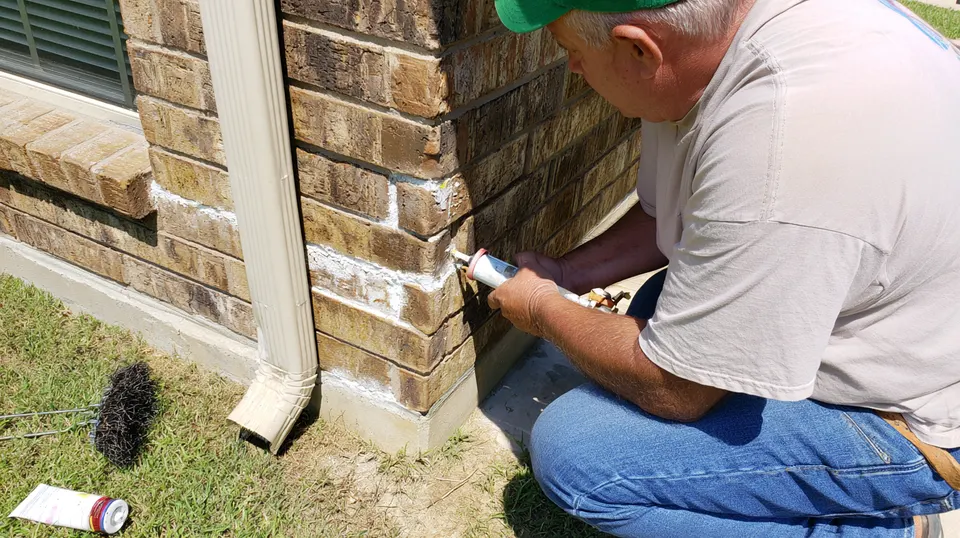
- Stair-step cracks in the brick veneer, especially at corners and running away from window and door openings.
- Doors and windows that stick, or a door that swings open or shut by itself because the frame is no longer square.
- A visible slope in the floor.
- Cracks in the slab itself, most visible in the garage, in a closet with no flooring, or under lifted vinyl.
- Sheetrock cracks running diagonally from the corners of door frames, or tape seams opening along the ceiling.
- A gap between the baseboard and the floor, or between the brick and the trim around the garage door.
- Separation where the slab meets a patio, porch or driveway, with one side higher than the other.
Several signs together on the same side, or any sign that has grown over a dry summer, calls for elevation readings. A foundation inspection in McKinney is free and gives you those readings in writing.
What slab foundation repair involves in McKinney
The soil under McKinney is the reason this work exists. The USDA NRCS Official Series Descriptions for the Houston Black and Heiden series, the two extensive Blackland Prairie clays in Collin County, put both at 40 to 60 percent clay with high shrink-swell potential, and describe surface cracks 1/2 to 4 inches wide (Houston Black) and 0.5 to 3 inches wide (Heiden) at 12 inches deep in dry periods. Texas A&M AgriLife soil scientist Dr. Jake Mowrer, quoted by FOX 7 Austin in August 2022, explains that these vertisols swell when wet and shrink when dry because water slips between microscopic clay layers, which is why foundation problems are so common in Texas. The Texas Comptroller’s December 2022 Fiscal Notes report describes 2022 as the worst drought in the state after 2011, with about 68 percent of Texas in extreme drought in mid-August. Dry summers like those pull the clay away from the slab edge, and the perimeter drops.
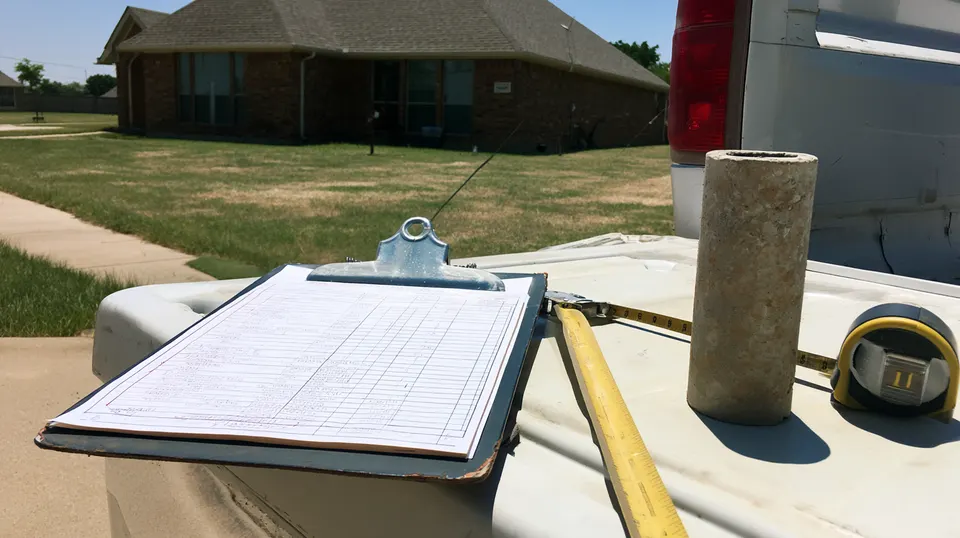
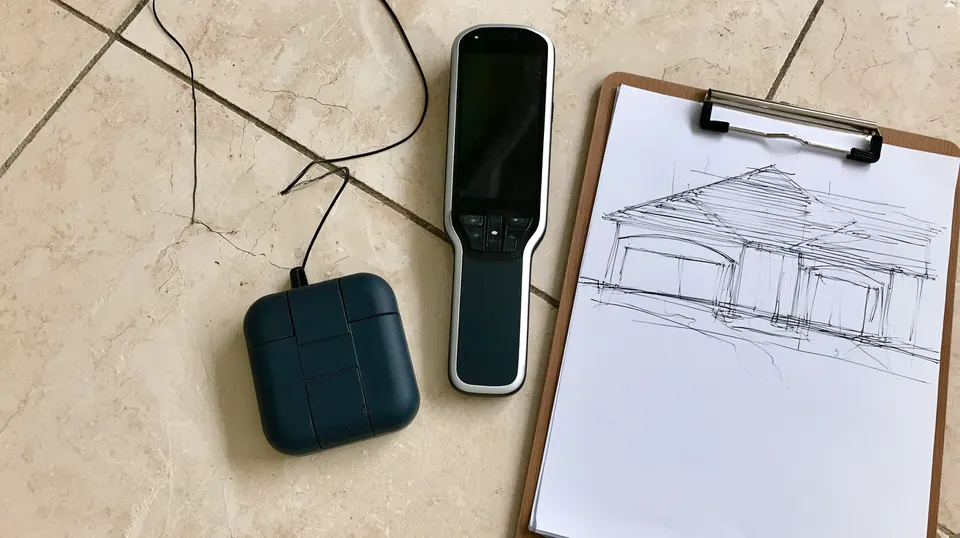
The repair itself follows a set order. The inspection comes first: a crew lead reads the exterior, then takes floor elevation readings across every room to map which parts of the slab have dropped and by how much. An engineer registered in Texas turns those readings into a pier plan.
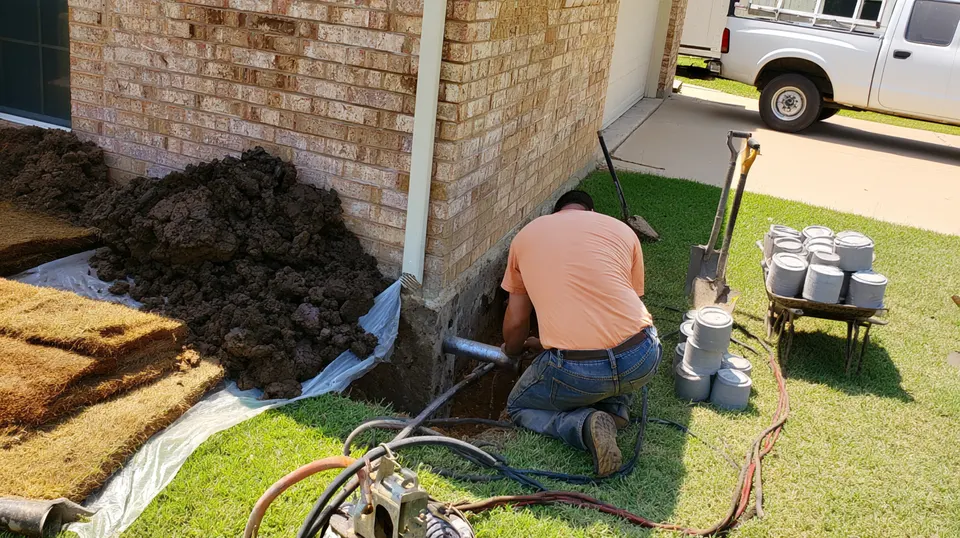
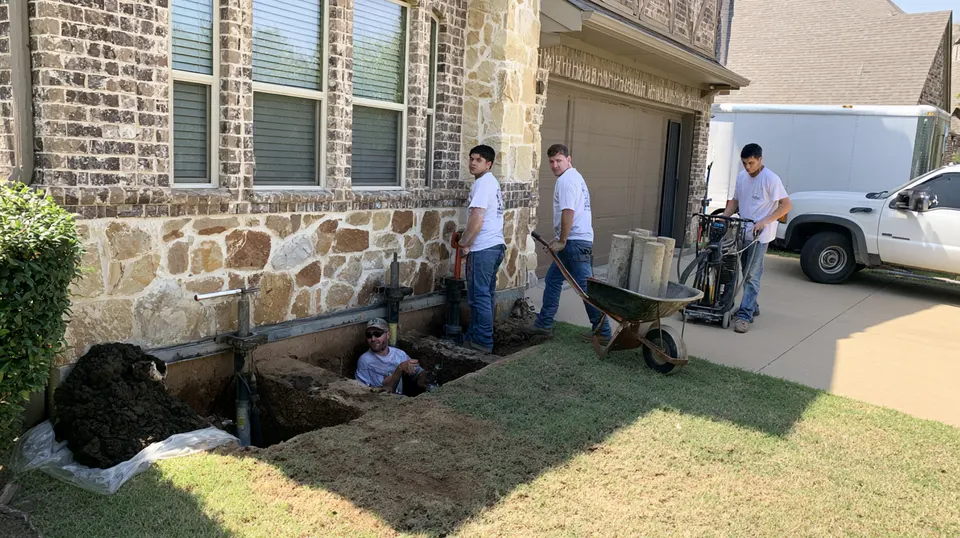
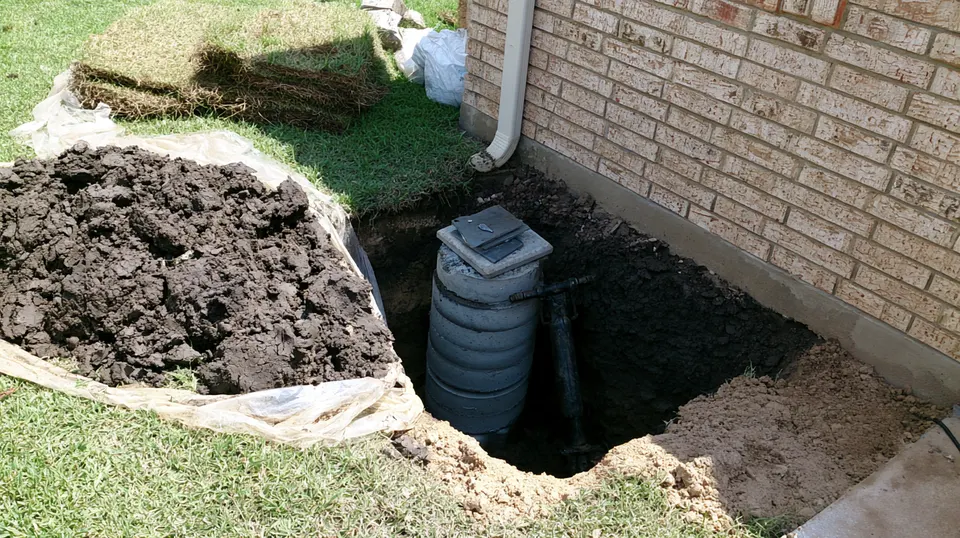
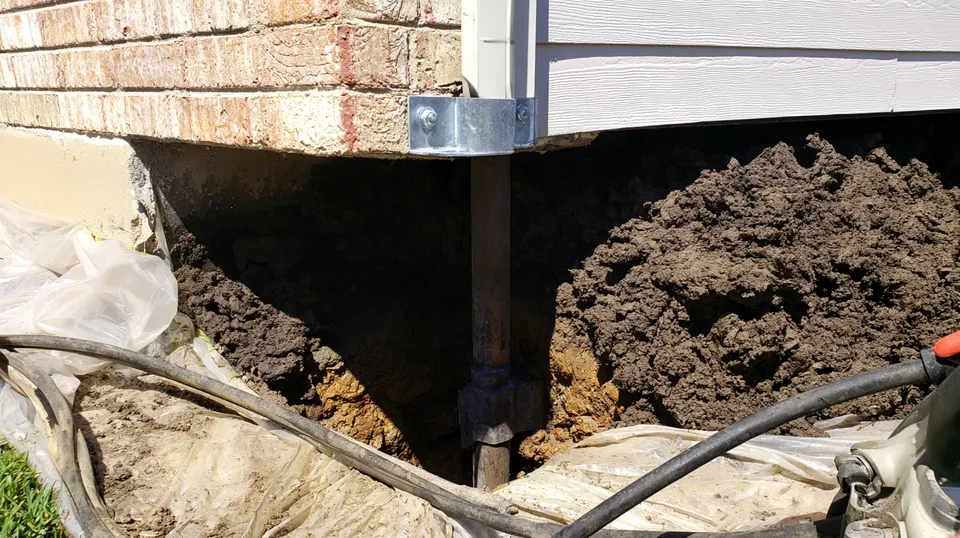
On day one of the repair, the crew marks each pier location along the dropped side of the perimeter and hand-digs a hole at each one, roughly two feet square, down to the bottom of the grade beam (the thick concrete edge of the slab). Two pier types do most of the work in McKinney:
- Pressed concrete piers: precast concrete cylinders pressed into the ground one on top of the next with a hydraulic ram that uses the weight of the house as the anchor, until the stack refuses to go deeper.
- Steel push piers: steel pipe sections driven the same way, which reach deeper and carry more load, chosen where the clay is deep or the house is heavy.
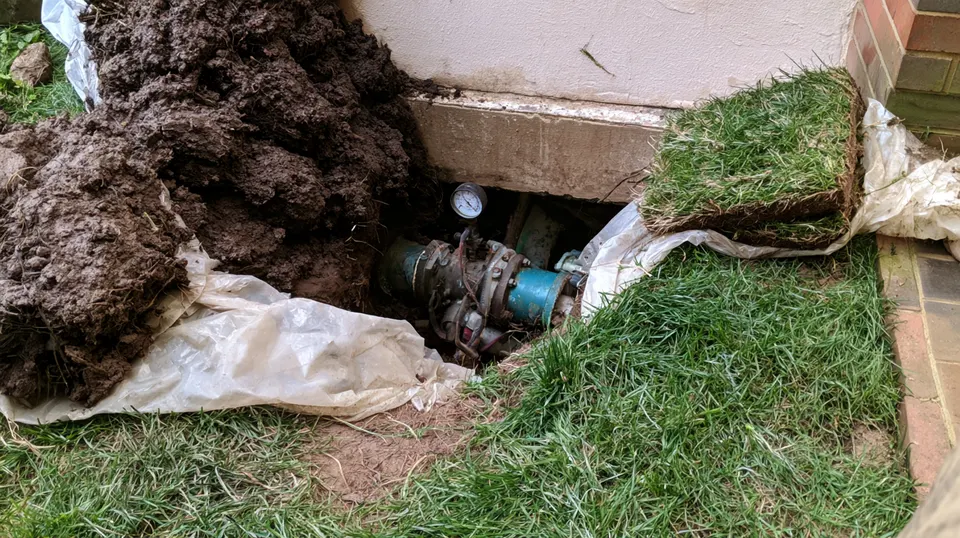
Interior piers, needed when the middle of the slab has dropped, are reached either by tunneling under the slab from the outside or by cutting through the floor. Once every pier is set, the crew places hydraulic jacks on the piers and lifts the slab a fraction of an inch at a time while a second person watches the readings, then locks each pier with steel shims and a concrete cap.
The City of McKinney Building Inspections General Guidelines for Foundation Repair require a permit for foundation leveling, pier or footing replacement and shimming on slab-on-grade homes. The application must include an engineer’s letter and drawings showing the affected areas and stating whether the plumbing will need testing, and the city closes the permit only after the final engineer’s report is uploaded to its CSS portal. Because drain lines are cast into a slab, a plumbing test before and after the lift is standard, and the contractor handles the permit, the engineer and the test.
- 1
Call or send a request
Call (972) 555-0100 or use the form. Tell us what you are seeing: cracks, sticking doors, sloping floors, or water where it should not be.
- 2
On-site inspection and written estimate
A crew lead measures the foundation with a level survey, checks the drainage, and writes an itemized estimate you keep. The estimate is free.
- 3
Scheduled work
You get a start date. Most residential pier jobs take one to three days. Landscaping is moved and put back.
- 4
Walkthrough and warranty paperwork
You walk the job with the crew lead, see the post-lift readings, and receive the written warranty and the engineer paperwork if your city required it.
Talk to a crew lead about your foundation today.
Call (972) 555-0100What slab foundation repair costs in McKinney
The two guides that break out cost by foundation type disagree on the width of the range. Fixr’s 2026 foundation repair guide puts slab repair at $1,000 to $10,000, spanning everything from a single crack seal to a full perimeter underpin, while Modernize’s 2026 guide puts a typical concrete slab job at $3,000 to $7,500. The number that drives a McKinney estimate is the per-pier figure, which Modernize’s 2026 guide lists at $1,000 to $3,000 per pier.
What it costs
$1,000 to $10,000
Fixr 2026 national range, cost by foundation type: slab.
$3,000 to $7,500
Modernize 2026 national range, cost by foundation type: concrete slab.
What moves the number in McKinney: whether the slab needs lifting (slabjacking or foam) or underpinning with piers, number of piers along the perimeter, interior piers that require tunneling or breaking through the slab, plumbing leaks under the slab, expansive clay soil movement and drainage correction.
Fixr's slab range ($1,000 to $10,000) is much wider than Modernize's ($3,000 to $7,500) because Fixr spans everything from a single crack seal to full perimeter underpinning, while Modernize describes a typical mid-scope slab job.
Estimates are free, written, and itemized. No price is quoted before someone has measured the foundation.
Those are national ranges from named guides, not quotes, and the pier count on your free written estimate is what sets the real number.
Piers, foam or both: the slab foundation repair McKinney homes need most
Homeowners ask two versions of the same question: can foam or grout lift the slab instead of piers, and if piers, steel or concrete?
Foam and grout (polyurethane injection and mudjacking, together called slab jacking) lift a slab by pumping material through small holes into the void under it. They are the right tool for a driveway, patio or garage floor that has sunk, and for an interior floor that has dropped between piers. They are the wrong tool for a perimeter that keeps dropping, because they fill the void without reaching past the active clay. Fixr’s 2026 guide lists mudjacking or slab jacking at $500 to $1,900 per job, and the concrete leveling page explains where it fits.
On steel versus concrete, the honest answer is depth and load. Pressed concrete piers are the common choice on a typical McKinney single-story or two-story brick house, and the pressed concrete piers page covers how far they can be driven. Steel push piers go deeper, reach a firmer stratum below the clay, and cost more per pier. A house whose readings show deep, uneven settlement is usually a steel pier job. The engineer’s plan makes the call, and the estimate should say which type, how many and where.
The housing stock shapes this too. The US Census Bureau’s ACS 2024 estimate puts the median year a McKinney housing unit was built at 2007, so most slabs here were poured under modern engineering with post-tension cables or heavy rebar, and they tend to tilt as a unit rather than break. That favors a perimeter lift with a modest pier count when the movement is caught early.
Related services
Slab work is the largest part of foundation repair in McKinney, and that page covers the inspection, the pier plan and how to judge a contractor. The pier choice is compared in detail on pressed concrete piers and steel push piers. If your only symptom is a crack in the slab, foundation crack repair explains when sealing is enough and when it is not, and the foundation repair cost page lays out the line items an estimate should show. Crews also cover Allen and Melissa.
Good slab foundation repair McKinney homeowners can rely on starts with elevation readings, ends with an engineer’s final report filed with the city, and carries a written warranty in between. Book the free inspection at (972) 555-0100 or through the free estimate form, and you will have the pier count and the price in writing before the crew lead leaves.
Questions homeowners ask
What is a slab-on-grade foundation?
It is a single slab of reinforced concrete poured directly on the ground, with thicker beams along the edges and under load-bearing walls. There is no crawl space or basement. Most McKinney houses are built this way, so most foundation repair here is slab repair.
How do crews reach piers under the middle of the house?
Two ways. Tunneling means digging a passage from the outside under the slab to the pier spot, which keeps your floors intact. Breaking through means cutting an opening in the floor from inside, setting the pier, and patching the concrete. The estimate states which method is planned and why.
Will slab repair damage my landscaping or floors?
Perimeter piers need a hole roughly two feet square at each spot, so plants and turf in that strip are lifted and replaced as best they can be. Interior piers by tunneling leave floors alone. Ask the estimate to spell out what restoration is included.
Why does the city want a plumbing test?
Lifting a slab can stress the drain lines cast into it, and a leak under a slab is also a common cause of the settlement in the first place. The City of McKinney's permit guidelines ask whether plumbing will need testing, so the contractor arranges a test before and after the lift.
How long do piers last?
Piers driven to refusal or to a stable stratum are permanent supports, and every job carries a written warranty that says so in plain terms. What can still move is the soil between piers and the unsupported parts of the slab, which is why drainage and watering habits matter after the repair.
Sources for local facts on this page
- Texas Section ASCE, Recommended Practice for the Design of Residential Foundations, Version 2, adopted Oct 4, 2007
- USDA NRCS Official Series Description, Houston Black series, 2026
- USDA NRCS Official Series Description, Heiden series, 2026
- Texas Comptroller of Public Accounts, Fiscal Notes, Drought in Texas, December 2022
- FOX 7 Austin, Texas drought may be impacting your home's foundation, Aug 2, 2022
- City of McKinney Building Inspections, General Guidelines for Foundation Repair, accessed Sep 2026
- US Census Bureau ACS 2024 1-year, table B25035, via Census Reporter, 2024
Free estimate
Get a free written estimate for slab foundation repair
A crew lead measures the foundation, explains what is moving and why, and hands you an itemized estimate you keep.
Call (972) 555-0100Mon to Sat 7am to 7pm