McKinney TX Foundation Repair
Foundation Drainage in McKinney, TX
Foundation drainage keeps water from pooling against a McKinney slab or crawl space so the clay under the house stays at an even moisture level all year.
Free estimate
Request a free estimate for foundation drainage
Tell us what you are seeing and a crew lead will call to set a same-week inspection in McKinney. No price is quoted until the foundation has been measured.
Prefer the phone?
Call (972) 555-0100Mon to Sat 7am to 7pm
Foundation drainage McKinney homes need is less about moving storm water off the lot and more about keeping the clay under the slab at an even moisture level all year. The soil here is Blackland Prairie clay, which swells when it gets wet and shrinks when it dries, and the foundation rides on top of that movement. Drainage work is the set of fixes that stops water from pooling against one side of the house after a storm: grading, gutters and downspout extensions, surface drains, French drains and, where nothing can drain by gravity, a sump pump. It is the least expensive part of foundation work and the part that keeps a repaired foundation repaired.
Estimates are free and written. Call (972) 555-0100 and a licensed and insured local crew will schedule a same-week visit, walk the lot to see where water runs, and write up the fixes in the order that matters most. Every job carries a written warranty.
Signs you need foundation drainage in McKinney
- Water stands against the foundation or in flower beds for more than a day after rain.
- Downspouts drop roof water straight onto the soil at the corners of the house.
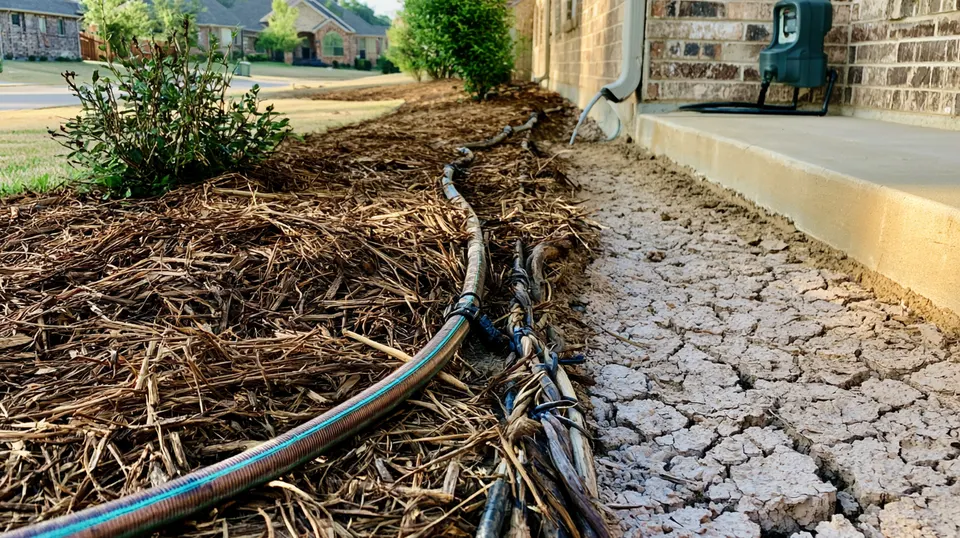
- The soil has pulled away from the slab edge in summer, leaving a gap you can put your fingers into.
- Mulch, grass or a patio slopes toward the house instead of away from it.
- A white powder called efflorescence shows on brick near the ground, or the lowest course of brick stays dark after the rest has dried.
- Doors and windows stick in wet months and free up in dry ones, which points to seasonal soil swelling.
- Cracks in the slab or the brick have appeared on the side of the house where water collects.
The seasonal pattern is the clearest tell. A house that changes with the weather is a house whose soil moisture changes with the weather, and drainage is how you flatten that curve. If the wet spot is inside the house or the water bill has jumped, a slab leak repair plumber should test the lines under the slab first, because no drain fixes a broken pipe.
What foundation drainage involves in McKinney
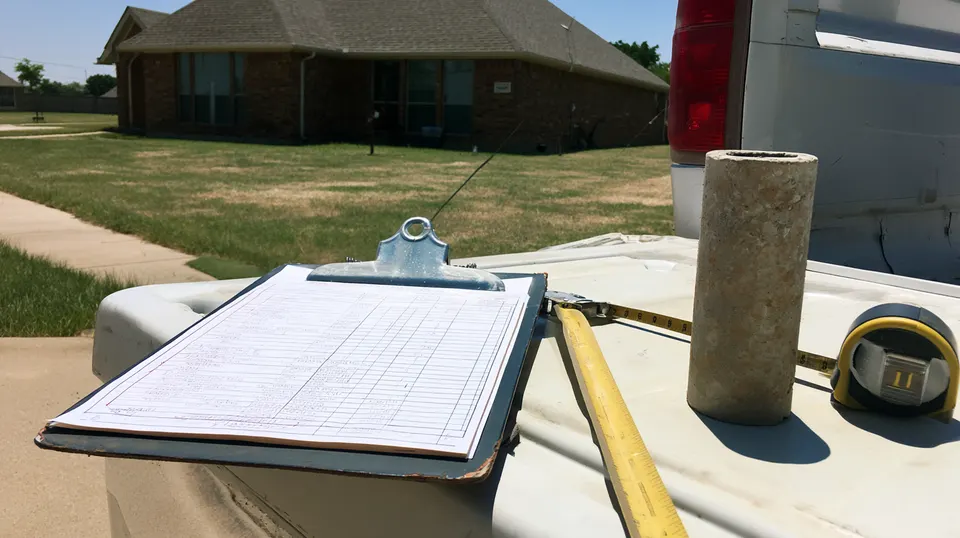
Day one is a walk of the lot with a level and, ideally, a look at the yard during or right after rain. The crew finds where roof water lands, where the ground slopes toward the house, where the soil stays wet and where it has cracked open. The fixes go in a set order because the cheap ones solve most of the problem.
Grading comes first. Soil should slope away from the foundation on every side, and a crew adds and compacts fill to build that slope where it has settled flat or reversed. Gutters and downspouts come next: any downspout that dumps at a corner gets an extension or a buried pipe that carries the water well away from the slab. Surface drains, which are grated boxes set in low spots and connected to a buried pipe, handle patios and side yards that cannot be regraded.
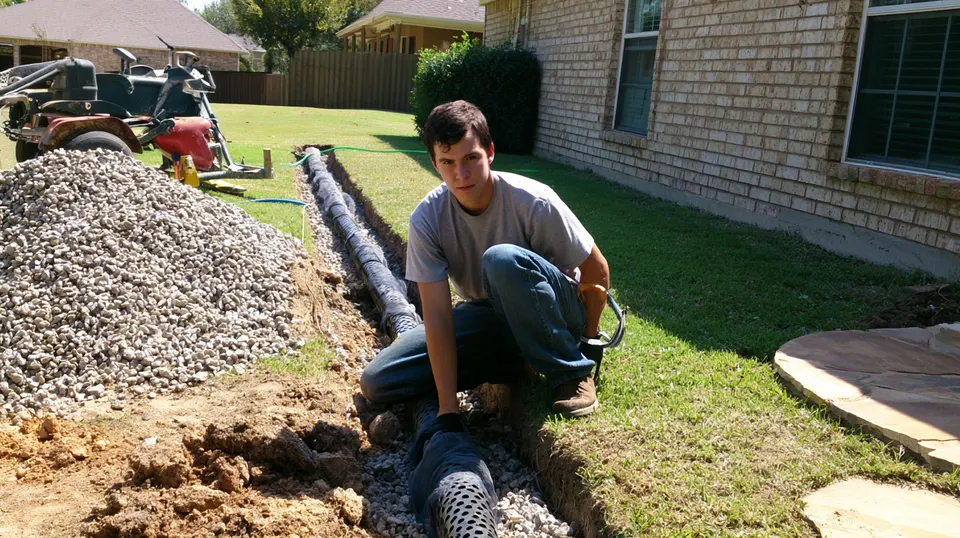
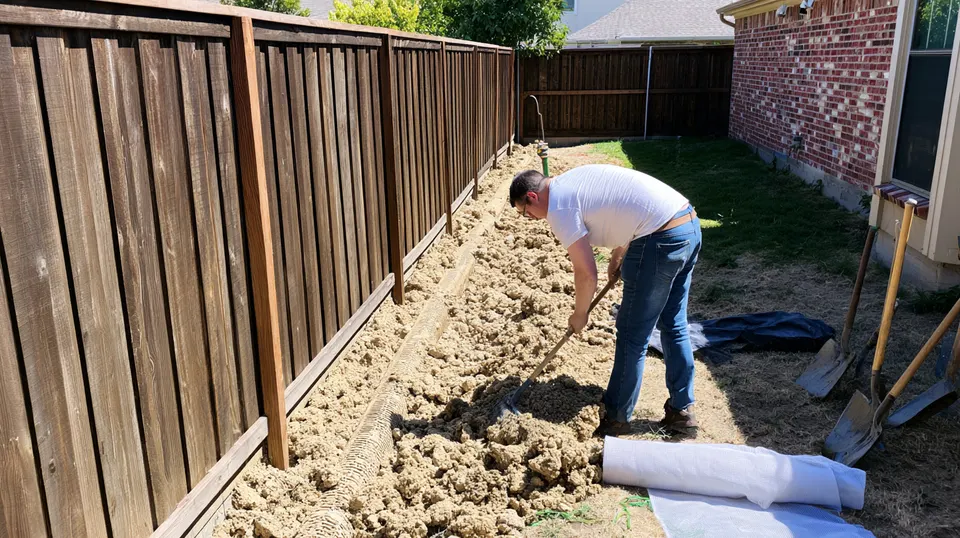
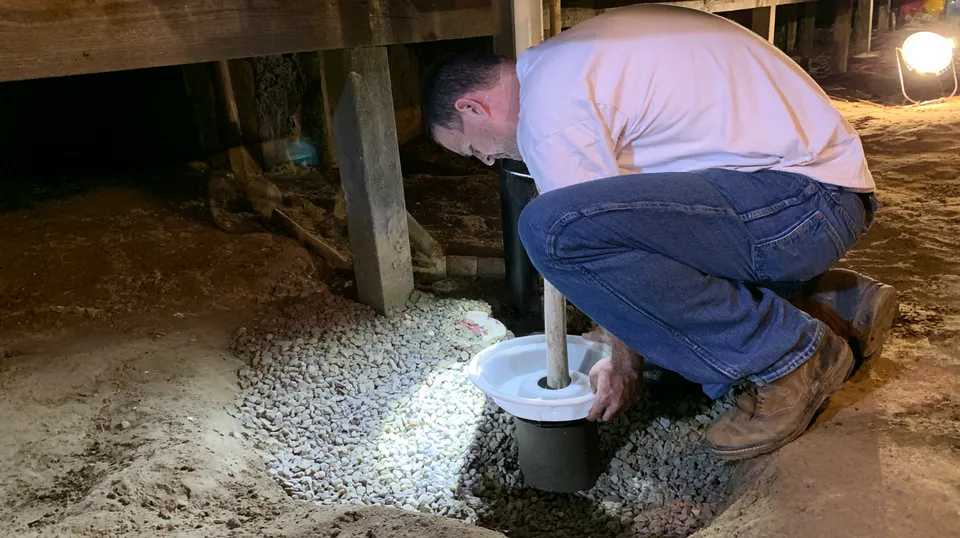
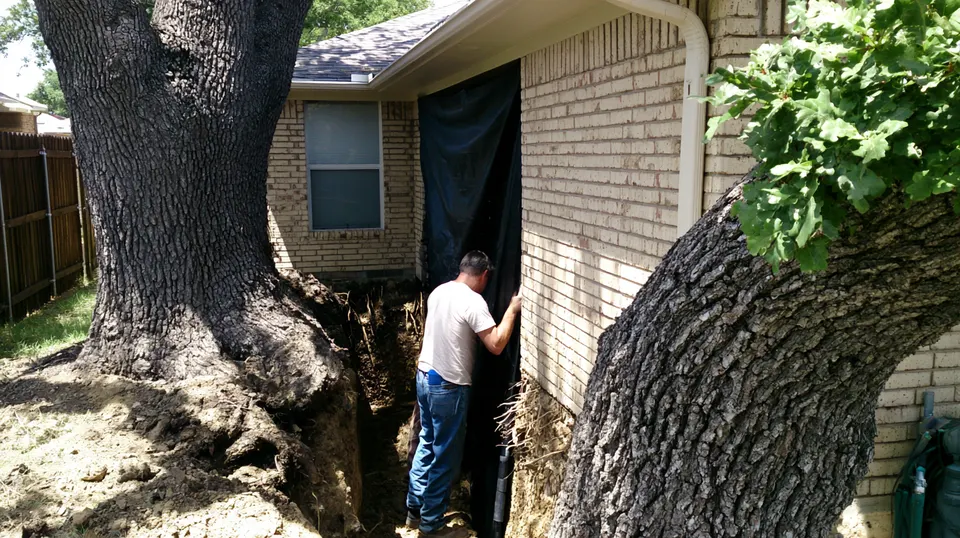
A French drain is a gravel filled trench with a perforated pipe at the bottom, laid along a wall or across a yard to catch water below the surface and carry it to a discharge point. It is the answer where a neighbor’s lot drains toward yours or where a side yard holds water. The French drain installation page covers trench depth, pipe and gravel. Where there is no place to discharge by gravity, a sump pump in a buried basin lifts the water out through a pipe to the street or a swale.
The reason all of this matters more here than in most places is the soil. The USDA NRCS describes the Houston Black series, the Texas state soil, as 40 to 60 percent clay with high shrink-swell potential, opening cracks half an inch to four inches wide at 12 inches deep during dry periods, and its fact sheet notes that water enters this soil rapidly when it is dry and cracked and very slowly when it is moist. The Heiden series, another Collin County clay, is also 40 to 60 percent clay and behaves the same way according to the NRCS. So a downspout dumping onto cracked summer soil sends water deep under one corner of the slab, that corner swells and lifts, and the rest of the house stays put.
Drainage on its own does not need a foundation repair permit in McKinney. The City of McKinney Building Inspections office requires a permit for foundation leveling, pier or footing replacement, shimming or floor system replacement, so when drainage is combined with piers the permit and the engineer’s letter apply to the pier work, and your estimate should show them.
Talk to a crew lead about your foundation today.
Call (972) 555-0100What foundation drainage costs in McKinney
Modernize’s 2026 foundation repair guide puts exterior drainage installation at $1,500 to $4,000, which is the usual scope around a McKinney slab. HomeAdvisor’s 2026 guides give a wider $1,500 to $15,000 for a full drainage system and $500 to $10,000, or $10 to $50 per linear foot, for an exterior perimeter drain, while This Old House’s 2026 guide prices interior drain systems by the foot at $60 to $120.
What it costs
$1,500 to $4,000
Modernize 2026 national range, exterior drainage installation on the foundation repair guide.
$1,500 to $15,000
HomeAdvisor 2026 national range, drainage system as preventive maintenance on the crawl space repair guide; exterior perimeter drain $500 to $10,000 on the French drain guide.
What moves the number in McKinney: drain type (surface, French, interior, footing), linear feet and trench depth, grading and downspout extensions, discharge point and sump pump, expansive clay soil moisture control.
Modernize's $1,500 to $4,000 covers a standard exterior drain around a slab. HomeAdvisor's $15,000 high end includes full interior drain tile systems for basements and crawl spaces. This Old House prices only by linear foot.
Estimates are free, written, and itemized. No price is quoted before someone has measured the foundation.
HomeAdvisor’s high end covers full interior drain tile systems that a McKinney slab home would not need, so an exterior job here usually lands near the Modernize range.
Which foundation drainage McKinney homes need first
Start with the cheapest fix that moves the most water. HomeAdvisor’s 2026 guide lists landscape grading at $1,000 to $3,300 per job, and This Old House’s 2026 guide lists gutter installation at $650 to $1,750, and between them those two fixes stop most of the water that reaches a foundation. A French drain is the next step, at $10 to $100 per linear foot in HomeAdvisor’s 2026 guide with a national average near $45 a foot, or $2,800 to $6,500 for a typical exterior run in This Old House’s 2026 guide. A sump pump, where gravity discharge is not possible, averages $1,400 in This Old House’s 2026 guide with a range of $500 to $4,000. Modernize’s 2026 guide also lists soil stabilization at $1,000 to $5,000 per job for lots where the clay itself needs treatment.
Rainfall here makes the order matter. The National Weather Service reports DFW Airport’s normal annual precipitation at 37.01 inches for the 1991 to 2020 period, with May the wettest month at 4.78 inches and July the driest at 2.08 inches. Wet Mays followed by dry Julys are the swing that moves foundations, and the swing from one year to the next is bigger still: 25.88 inches in 2011, 62.61 inches in 2015, and 29.31 inches in 2023, with only 1.25 inches falling from June through August of 2023. Drainage handles the wet half of that cycle. The dry half is handled by foundation watering, which keeps soil moisture even during drought, and by a root barrier where a large tree is pulling water from under one side of the slab. Texas A&M AgriLife soil scientist Dr. Jake Mowrer, quoted by FOX 7 Austin in August 2022, explains that these clays swell when wet and shrink when dry because water slips between microscopic clay layers, which is why foundation problems are so common in Texas.
A drainage plan for a McKinney lot, then, is a list in order: grade, extend the downspouts, add a surface drain where a patio traps water, run a French drain where the soil stays wet below the surface, and add a sump pump only if there is nowhere lower to send the water. The written estimate should show that order and price each step so you can stop where the problem stops.
Related services
Drainage is one piece of moisture control. The French drain installation and sump pump installation pages go deeper on the two mechanical fixes. Foundation watering and root barrier installation handle the dry side of the cycle. If movement has already cracked the slab, the foundation repair cost page shows what piers and crack repair run nationally. Crews also cover Prosper and Fairview.
The foundation drainage McKinney homes need is grading, gutters and a French drain where the lot calls for one, installed before piers are needed or right after they go in. Call (972) 555-0100 for a free on-site estimate this week.
Questions homeowners ask
Does foundation drainage really prevent foundation repair?
It removes the most common cause. The clay under McKinney swells when it gets wet and shrinks when it dries, and a foundation moves with it. Keeping water from pooling on one side and drying out on the other keeps that movement small and even, which is what a slab or pier and beam home needs.
What is the first drainage fix I should make?
Grading and downspouts. Soil should slope away from the house on every side, and each downspout should discharge several feet from the foundation. Those two fixes handle most roof and surface water and cost less than any drain.
Do I need a permit for foundation drainage in McKinney?
Drainage work on its own is not a foundation repair permit item. The City of McKinney requires a permit for leveling, pier or footing replacement, shimming or floor system replacement. If drainage is combined with pier work, the permit and engineer's letter apply to the piers.
What is a French drain?
A French drain is a gravel filled trench with a perforated pipe at the bottom. Water in the soil seeps into the gravel, enters the pipe and flows to a discharge point away from the house. It is used along walls or across yards where surface grading cannot move the water.
My yard drains fine but the slab still moves. What else could it be?
Dry side movement. In a hot summer the clay shrinks and pulls away from the slab, and a large tree can pull water from under one corner. Foundation watering and a root barrier handle that side of the cycle. A plumbing leak under the slab is the other thing to rule out.
Sources for local facts on this page
- USDA NRCS Official Series Description, Houston Black series, 2026
- USDA NRCS, Houston Black Texas State Soil fact sheet, 2026
- USDA NRCS Official Series Description, Heiden series, 2026
- City of McKinney Building Inspections, General Guidelines for Foundation Repair, accessed Sep 2026
- National Weather Service Fort Worth, DFW Annual Normals, Means and Extremes, 2021
- National Weather Service Fort Worth, DFW Monthly and Annual Precipitation, 2026
- FOX 7 Austin, Texas drought may be impacting your home's foundation, Aug 2, 2022
Free estimate
Get a free written estimate for foundation drainage
A crew lead measures the foundation, explains what is moving and why, and hands you an itemized estimate you keep.
Call (972) 555-0100Mon to Sat 7am to 7pm